Many Christians have reached for biblical analogies to understand Donald Trump’s presidency – Cyrus, Nebuchadnezzar, even King David. But I want to suggest that perhaps the most instructive comparison is not a flattering one. It is Israel’s first king, Saul.
I’m not arguing that Trump is Saul in a one‑to‑one prophetic fulfillment. Scripture is not a codebook for modern politics. But Saul’s story exposes something about both leaders and the people who choose them, and in that mirror, we may see more of ourselves than we’d like.
When Israel first demanded a king, it wasn’t primarily a policy request; it was a heart cry: “Then we shall be like all the other nations, with a king to rule us, to lead us out and to lead us in and fight our battles” (1 Sam. 8:20).
They were not content with an unseen King and flawed but faithful judges. They wanted someone visible, forceful, and impressive who could promise safety, strength, and national greatness. In that moment, God told Samuel, “They have not rejected you, but they have rejected me from being king over them” (1 Sam. 8:7).
The problem was not monarchy itself; it was the motive: a transfer of trust from God to a human strongman. When many American Christians rallied around Donald Trump, it was often with a similar heart posture: “He will fight for us. He will protect us. He will win for us.” The language of political salvation – “only Trump can fix it” – began to creep into our discourse. That desire for a warrior‑king to fight our cultural battles is where the Saul comparison first emerges.
Saul emerged onto the scene as the kind of leader people could rally around. 1 Samuel 9 tells us that he was tall, striking, and from a wealthy family. When he was presented to the people, they shouted, “Long live the king!” (10:24). He looked like strength incarnate.
In the early days, Saul even projected a rough kind of humility – hiding among the baggage when chosen (10:22), but the narrative hints that this was more insecurity than genuine meekness. Israel, for its part, was eager to overlook the warning signs. They got exactly what they asked for: a king who looked strong and made them feel powerful.
In a different cultural key, Donald Trump’s political rise shared similar dynamics. He was not chosen because he was the most Christlike, but because he looked and sounded like the kind of fighter many felt they needed – wealthy, brash, unashamed to dominate opponents and “hit back.”
Like Israel, many believers were willing to minimize clear character problems because their candidate looked like the protector they wanted. Saul kicked off his rule shortly after his coronation by winning a convincing battle against an Ammonite king by the name of Nahash, which showcased his military prowess and reinforced the case that he could be the one would take command and use his knowledge and strength to lead Israel to new levels of glory and prosperity.
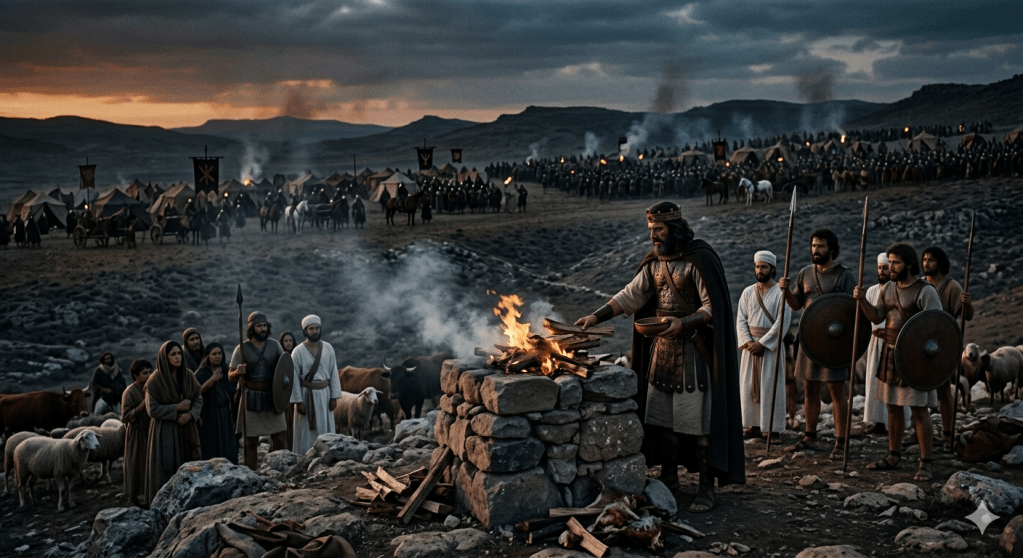
But Saul’s kingship slowly unraveled – not because he lacked military skill, but because his heart posture toward God was fundamentally self‑centered. In 1 Samuel 13, Saul sees his odds of success in battle against the Philistines slipping away while he awaits for the arrival of Israel’s spiritual leader, judge, and prophet Samuel to come and offer a sacrifice to God – seeking God’s favor and blessing upon the battle to come. Impatient and anxious, Saul instead seizes the spiritual mantle he was never meant to carry and offers sacrifices himself. This was no small sin, but a blasphemous overreach that grieved the heart of God. Saul doesn’t repent. At Samuel’s rebuke, he deflects and offers excuses to attempt at justifying his actions (13: 11-12).
Further into 1 Samuel, after sharp rebuke and the removal of God’s anointing, Saul’s language and actions demonstrate the behavior of a man who is more interested in maintaining his projection of power, and enviously attacking anyone he perceived as a threat to his power and image – even loyal subjects like David. Saul wrapped all of this in religious language, but at the core was a refusal to let God truly be king.
Saul was “head and shoulders above” the people. His physical presence reassured Israel that they had a strong king, even when his inner life was shallow.
American politics is saturated and infatuated with image. Trump, by design, projects wealth, dominance, and success: gold adornments, high-rises, bold promises, sharp insults, and the constant projection of winning. For many, this image of strength mattered more than deeper questions of truthfulness, humility, or moral character. In that sense, like Israel, we were drawn to a king who “looked the part.”
Saul insisted, “I have obeyed the voice of the Lord,” even while keeping what God had forbidden (15:13–15). He measured obedience in terms of outcomes that suited him.
In Trump’s case, many Christians excused or rebranded clearly unchristian behaviors – pride, cruelty in speech, contempt for enemies – because he delivered on certain political outcomes: judges, policies, perceived protection of the church. The moral calculus became, “As long as he fights for us, we can live with the rest.”
That doesn’t mean every policy was wrong, but it does echo Saul’s mindset: partial obedience wrapped in religious language and defended as “necessary.”
Saul’s reign was marked by a snowballing insecurity. Every song that praised David felt like an existential threat: “They have ascribed to David ten thousands, and to me they have ascribed thousands… What more can he have but the kingdom?” (18:8).
Trump’s rhetoric often reveals a similar fragility: constant need to boast crowd sizes, ratings, victories; relentless attacks on critics; deep sensitivity to perceived slights. The strongman persona often looks like Saul’s armor – impressive on the outside, hiding a fearful heart within.
But, if you’ve chosen to read this far you may wonder why I’ve found it necessary now to post these thoughts. Why does this matter to me as a pastor? Why should this matter to the church?
The more I read Saul’s story, the less I find myself asking, “How much is Donald Trump like King Saul?” and the more I find myself asking, “How much are we like Israel?”
We were afraid of cultural loss, so we demanded a strong king to “fight our battles.”
We were willing to overlook un-Christlike behaviors if we thought he would secure our safety.
We listened more readily to voices that promised protection and power than to the quiet voice that called us to repentance, holiness, and sacrificial love of enemies.
And Trump has, indeed, won some battles that the church has been passionately fighting. The selection of a Supreme Court justice instrumental in the reversal of pro‑abortion legislation like Roe v. Wade was one such landmark. He has pushed back on what many of us see as the serious harms of gender‑transition procedures for children and on policies that allow biological males access to spaces traditionally reserved for women’s privacy and safety. He has built a reputation as a “friend of the church” by defending religious liberty and the right to assemble for worship.
Likewise, Saul – for all his faults, failures, and insecurities that eventually consumed him – did not openly champion the foreign gods or morality of surrounding nations. Those nations embraced practices we would rightly name as evil: child sacrifice and the idolization of sexual immorality and prostitution as acts of worship. In a different presentation package, these issues are still at stake in modern American politics. Though Trump has had his fair share of moral failure, especially in his past, on many key policy issues he has held a generally conservative line.
But somewhere along the line, this has made President Trump a legendary figure of sorts for a large swath of the church. “We finally have the strong pro‑Christian leader we’ve always wanted,” seems to be the resounding sentiment. “We can look past the combative, uncharitable rhetoric, the pride, and the contempt because he fights for the church.” But is his leadership really a net positive for the church? Not for America. For the church.
On Monday morning, many awoke to a startling social media post by President Trump depicting him in the white robe and red sash or stole that, in the art world, is almost universally synonymous with Jesus Christ. His hands were aglow with mysterious power as he touched the head of a bedridden man in need of healing. For many of us, the implication was hard to miss: Donald Trump had placed his own image in a role that Christian art typically reserves for Jesus Himself.
This was not dramatically different from the kind of social media content he often shares. He (or his team) has used AI‑generated images with regularity, both to demean opponents and to cast himself as various heroic or powerful figures. But this time, for many believers, it crossed a line.
The Holy One, existent before all time and all creation – the Alpha and the Omega, the King of kings and Lord of lords, the perfect spotless Lamb whose blood alone is sufficient to cover every sin and whose resurrection is our only hope for this life and the next – was effectively echoed by a political image. The one who will return in righteous judgment and rule with the Father in the new heavens and new earth was implicitly paralleled with a human leader. However it was intended, the effect was to place Trump in a space that belongs only to Christ.
The backlash, even among many who are usually strong supporters, was quick and decisive. “This is not okay,” was the prevailing sentiment among Christians.
It was as if we were watching, in real time, a modern echo of Saul seizing the sacrifice and stepping into a role that was never his to take. After a few hours, the post was removed. When asked about it later, Trump said he had posted it because, in his mind, he looked like a doctor. It is difficult to reconcile that explanation with the image itself. Rather than clearly acknowledging that the post was inappropriate, there was an attempt to minimize and explain it away.
If you place that moment next to 1 Samuel 13, the parallels are sobering.
And the reason this matters is because protecting the message and the witness of the church is far more important than defending our institutions, our political influence, or our positions of power.
Many believers I’ve spoken with have written off his behavior and rhetoric as the necessary cost of protecting the interests of the church by protecting American liberty – not merely tolerating his leadership, but at times embracing it enthusiastically. I’ve known many sincere Christians who express their support through red hats, flags, yard signs, and bumper stickers. For some, the very qualities that trouble others – the macho, crude, combative nature of his leadership – are seen as part of what makes him effective. “He fights,” they say. “He doesn’t back down.”
Around all three elections he has been a part of, I’ve been asked as a pastor to pray specifically for Trump’s victory because “he has been chosen by God to lead our nation.” I’m beginning to believe those appeals may have been right – but perhaps not in the way many people assumed. Saul, too, was anointed by God to lead His people. Not as an instrument of grace, but, at least in part, as an instrument of judgment.
When Israel asked for a king, God warned them what it would cost. They would gain the security they craved, but they would also bear the weight of a leader who did not fully share God’s heart. They would still be called God’s people, but their life together would be marked by compromise, conflict, and confusion about where their true hope lay.
I am concerned that we are in a similar place.
The question is not simply, “Is this policy good or bad?” or even, “Will this candidate protect our freedoms?” Those questions matter, and Christians should wrestle with them seriously. The deeper question is, “What story does our political enthusiasm tell about the God we serve?”
When we rally more passionately around a personality than around the person of Jesus; when we excuse what we would otherwise call sin because it is “on our side”; when we are quicker to defend a leader than to lament his pride or blasphemy – our neighbors are watching. They are learning from us what we truly value, what we truly trust, and whom we truly worship. Gains we make politically should give us pause if they cost us evangelically.
Our witness is more precious than our position. Our credibility for the gospel is more valuable than our place at the table of power. The church has suffered loss, persecution, and marginalization many times in history and has often emerged purer and more compelling. But whenever the church has traded its prophetic voice for proximity to Caesar, it has always paid a devastating price.
I am not arguing for political withdrawal, nor am I suggesting that Christians may not, in good conscience, reach different conclusions about candidates and policies. I am pleading, instead, that we remember what is at stake. We are first and foremost ambassadors of a crucified and risen King, not chaplains of any party or personality.
If God has, in His sovereignty, given us a “Saul moment” in our national life, then perhaps the point is not that we finally have the champion we always wanted, but that He is exposing what we have come to want most. Maybe this is less a sign of divine favor than a gracious warning: do not put your trust in princes, in human beings, who cannot save (Psalm 146:3).
So before we jump in to dismiss, let us wrestle honestly with these questions before and during the next event that one of our leaders puts us in an uncomfortable and unflattering place:
- Does this adorn the gospel, or distract from it?
- Does this make Jesus more believable to my neighbors, or less?
- Does this reflect the character of the One who told us to love our enemies and bless those who persecute us?
In the end, kings rise and fall. Courts shift. Laws change. Nations come and go. But the church’s calling does not. We bear the name of Christ. We proclaim His kingdom. We embody His cross-shaped love in the world.
May we be willing to lose our personal upper-hand rather than lose integrity. May we be willing to surrender the trophies of our conquests rather than surrender our prophetic voice. And may we repent, where we have enthroned any earthly leader in our hearts, and return again to the only King who laid down His life for His enemies.
Because the world does not ultimately need to see how fiercely we can defend our institutions. It needs to see how clearly we belong to Jesus.


Leave a Reply