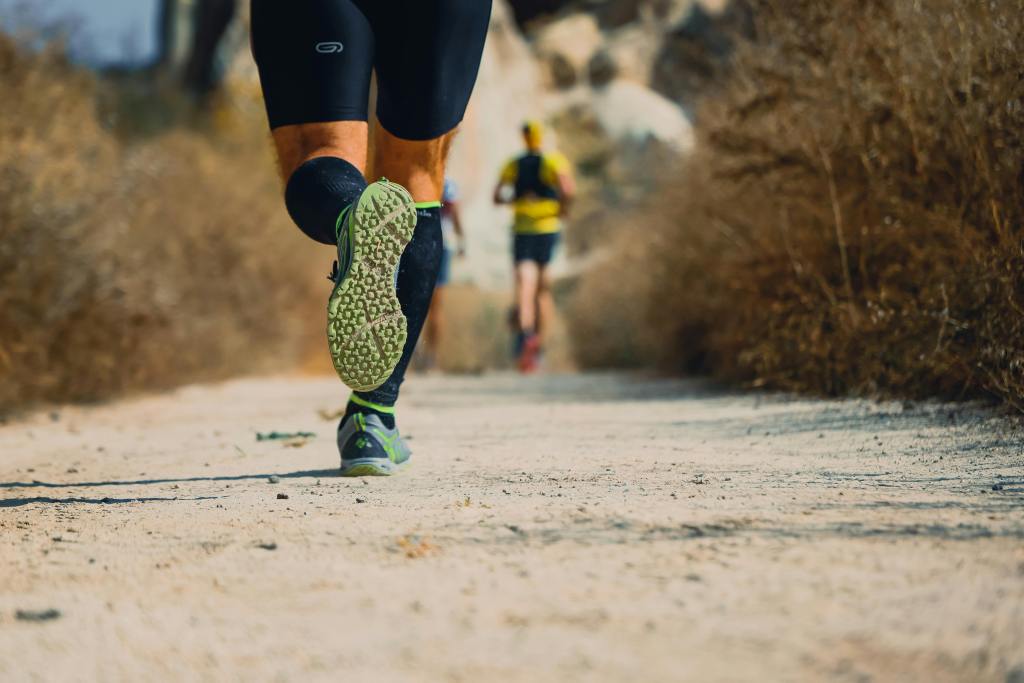
Last year, for the first time in my life, I trained for and ran all 26.2 miles of a marathon.
And not just any marathon.
This course wound through the mountains – up and down rugged terrain, over rocks and roots, with climbs that felt like they’d never end. It tested my body, my mind, and my willingness to push through exhaustion and self‑doubt. By the time I finally crossed the finish line, that moment wasn’t just one big, dramatic accomplishment. It was the tangible result of months of unseen work – day after day of pushing myself a little further than I thought I could go. I had done something I honestly never believed I could accomplish.
Then after the race ended in October, I stopped running.
One of my knees had taken a serious beating during my very rapid training window. It went from aching to screaming after 26 miles in the mountains. I knew I needed to back off. So I went into “recovery mode”: weekly physical therapy sessions while taking it easy.
And by “taking it easy,” I mean the candy of Halloween, the overindulgence of Thanksgiving, the cookies and treats of Christmas. You get the picture.
By the time 2026 rolled around, I had put on more than a little weight and shrunk the number of clothing options in my closet that actually fit. For those wondering why I’ve taken a liking to flannel shirts as of late – well…they’re the only things left!
A few weeks ago, my physical therapist looked at my progress and said something I’d been waiting months to hear: my improvements were to the point that I should start testing out my knee again. I was almost “graduated” from physical therapy.
This was incredible news. For the first time in six months, I laced up my running shoes, stepped onto the trail, and started to run.
And I barely made it to mile three.
My last run had taken me to what, for many runners, is the pinnacle of endurance. Now, most of that endurance was gone. My body reminded me – very quickly -that fitness is perishable. What you don’t maintain, you lose.
But here’s the key: I haven’t stopped.
I’m back out there, and I’ve noticed that week by week, I’m getting just a little better each time I hit the trail. The distances aren’t impressive yet. The pace isn’t remarkable. But the direction is right.
Why?
Because discipline matters.
Body and Soul: How We Steward Ourselves
What I’m relearning with my body has been quietly preaching to my soul.
We tend to separate physical health and spiritual health, as if they live in different universes. In reality, they are often deeply connected. We are not disembodied spirits. God created us as whole people -body, mind, and spirit intertwined.
When I’m a good steward of my body – when I pay attention to rest, exercise, and what I put into it – it often spills over into how I steward my mind and spirit.
- When I’m disciplined with movement, I tend to be more alert in prayer and scripture.
- When I fuel well, I notice more mental clarity for reading, studying, and listening for God.
- When I honor physical limits and rest, I’m more emotionally available to others and more open to God’s voice.
On the flip side, when I drift physically – too much sugar, too little sleep, no movement – it’s amazing how quickly my spiritual life starts to feel dull, foggy, and unmotivated.
The point isn’t that running or fitness automatically equals holiness. It’s that discipline in one area often awakens us to the need for discipline in others. Stewardship is a habit that tends to spread. And at least for me, when I’m out of shape in one area, it becomes a signal that maybe my disciplines are lacking everywhere. Spiritual fitness, like physical fitness, is something worth working toward.
When We Want More Faith, But Only Wish for It
Many of us, if we’re honest, have moments where we wish our faith meant more.
We wish our relationship with God felt more vibrant, more alive, more fulfilling. We wish Scripture felt less confusing and more like a conversation. We wish prayer didn’t feel so forced or awkward. We wish worship moved us deeply again.
But often, we stop at wishing.
If I’m not careful, I can treat spiritual vitality like I sometimes treat fitness: as something I’ll “get back to” eventually, once life slows down, once I feel more motivated, once conditions are perfect.
Imagine if that thinking was applied to marathon training:
- “I wish I could run 26 miles, but I don’t feel like lacing up today.”
- “I’d love to finish a race like that… someday… without changing anything I’m doing now.”
It sounds absurd in the context of running, but we do exactly that with our spiritual lives.
We want intimacy with God without making room for it.
We want a stronger faith without training it.
We want depth without discipline.
Spiritual vitality takes work. Not work that earns God’s favor – Jesus has already secured that for us – but work that responds to His love. It is worth investing in.
Starting Again (Or For the First Time) Is Awkward
Getting back to running after months off has reminded me of something important: starting again is hard.
It feels clunky and awkward. My breathing is heavier. My legs feel tired way earlier than they “should.” My last run, the temperatures were in the mid-80’s (in April!) and that made it even more of a slog. I’m painfully aware that I’m not where I used to be.
We can apply the same truths spiritually.
If you haven’t prayed consistently in a long time, your first attempts might feel forced.
If you’re not used to reading Scripture, those first chapters can seem confusing or dry.
If you haven’t been in Christian community, showing up to a group or a church service can feel intimidating and vulnerable.
It’s easy to interpret that awkwardness as failure: “I must not be good at this.”
“Maybe this just isn’t for me.”
“Other people are naturally spiritual; I’m just not.”
But awkward is normal when you’re building (or rebuilding) any kind of discipline.
The fact that it feels hard doesn’t mean you’re doing it wrong. It means you’re using muscles – physical or spiritual – that have gone untrained for a while.
The key is not to let that initial discomfort talk you out of beginning.
Just like I had to accept my three-mile limit as a starting point, we have to accept where we are spiritually as a starting point – not as our entire potential.
The Prize Is Worth the Pain
The Apostle Paul loved athletic imagery, and I understand why more now than ever. He wrote in 1 Corinthians 9:
“Do you not know that in a race all the runners run, but only one receives the prize?
So run that you may obtain it.” (v. 24)
Paul isn’t telling us to compete against each other, of course. He’s telling us to take our spiritual lives as seriously as an athlete takes their race – to train with purpose, to live with intention.
Training for a marathon taught me that there are many mornings when you don’t feel like getting out the door. There are long runs where everything in you wants to quit before you’re even halfway there. There are hills that make you question every decision in your life that took you to that point.
But then there’s the finish line.
That quiet, tear‑filled, exhausted joy of realizing:
“All of that was worth it. Every early alarm. Every sore muscle. Every time I didn’t quit.”
In a much deeper way, following Jesus, practicing spiritual disciplines, and staying in the race of faith lead to a prize that far outweighs the cost.
- The “finish line” here is not a medal; it’s knowing Christ more deeply.
- It’s becoming more like Him in our character.
- It’s living with a growing awareness of His presence and power in our daily lives.
- It’s hearing, one day, “Well done, good and faithful servant.”
That is worth pushing through the awkward, worth persisting when you don’t feel spiritual, worth continuing when growth seems slow.
Where to Begin
If any of this resonates with you, here’s the encouragement I’m preaching to myself:
- Start small. Don’t wait until you can “run a marathon.” Start by just getting on the trail. Start with ten minutes of Scripture and prayer. Start where you are.
- Expect awkwardness. Early miles feel rough. Early attempts at spiritual disciplines might too. Keep going anyway.
- Connect your body and soul. Let your run or walk become a place you invite God into – turn some of that time into prayer or reflection. Often, on the trail, I’ll listen to sermons or to the scriptures themselves.
- Remember the goal. The goal isn’t to be impressive; it’s to be faithful. It’s not to check boxes; it’s to know Jesus and be shaped by Him.
Week by week, I’m seeing tiny progress on the trail again. It’s slow, but it’s real.
I’m praying for the same in my spiritual life – that step by step, day by day, the disciplines practiced would train my heart to love God more, to trust Him more, and to obey Him more quickly.
Discipline matters. In our bodies and in our souls.
And by God’s grace, the prize is worth every mile.


Leave a Reply