
Daniel L. Rogers

A collection of thoughts and ideas too large for social media from the heart and mind of a WV Pastor.

  • The road a pastor walks is a lonely one.

    Not because pastors don’t like people, or because they prefer to keep others at arm’s length, but because friendship with members of their own congregation can quietly undermine the very role they’ve been called to fulfill: exercising spiritual authority for the good of the church.

    That tension sits underneath almost everything a pastor does.


    The Weight of the Pastoral Call

    Ephesians 4:11–13 paints a clear picture of the pastor’s calling:

    “So Christ himself gave the apostles, the prophets, the evangelists, the pastors and teachers, to equip his people for works of service, so that the body of Christ may be built up until we all reach unity in the faith and in the knowledge of the Son of God and become mature, attaining to the whole measure of the fullness of Christ.”

    The pastor’s primary responsibility is to equip God’s people for service and to shepherd them toward maturity in Christ. That’s not a casual task. There is a certain gravitas to the pastoral vocation.

    Ordination rites—however they’re practiced in a given tradition—are more than ceremonial formalities. They are the church’s public recognition that this person’s doctrine, character, and calling have been tested; that their words and theology now carry spiritual authority within that community. In essence, the wider church says, “We trust this one to speak God’s Word to God’s people.”

    Because of this, a pastor is given a pulpit and a platform. That’s not about ego or status; it’s about responsibility. The pastor is:

    • A Bible teacher, charged with handling the Word accurately.
    • A prophetic voice, called to speak truth even when it’s costly.
    • A shepherd, responsible not only for comforting but also for correcting.

    Part of pastoral ministry is offering loving correction—challenging believers to more closely align their lives with the Gospel. And that’s exactly where things get complicated when close friendship is involved.


    When the Word of God Hurts

    Hebrews 4:12–13 tells us:

    “For the word of God is alive and active. Sharper than any double-edged sword, it penetrates even to dividing soul and spirit… it judges the thoughts and attitudes of the heart. Nothing in all creation is hidden from God’s sight…”

    Scripture doesn’t just inform us; it confronts us. It cuts. It exposes. It penetrates our defenses and lays bare what we’d rather keep hidden.

    In most churches today, the person most visibly entrusted with bringing that Word to bear on hearts and lives is the pastor. Week after week, pastors are the primary mouthpiece of God’s Word for their congregations. That reality makes it even more crucial that a pastor operates faithfully within their spiritual authority and gifting, because:

    • We are entrusted with the most important message in human history.
    • We are called to handle it with accuracy, courage, and compassion.
    • We are responsible for how we steward the influence God has given us.

    When Scripture cuts to the core of a person’s heart, it matters who is wielding that blade. When the one speaking is a trusted spiritual guide, the hearer can—at least in theory—believe that the wound is meant to heal, not to harm. Like a surgeon who must cut in order to remove what’s killing the patient, Scripture wounds to restore.

    Or to use a different image: like an artist with a chisel and stone, God uses His Word to chip away everything in us that doesn’t belong. The blows can be jarring. The chisel marks can feel harsh. But the intent is not destruction; it’s transformation—forming us more clearly into His image.

    That doesn’t mean it doesn’t hurt. It often does.

    And when that chisel blow comes from someone you also regard as a close friend, the experience can become far more complicated.


    When Friendship and Spiritual Authority Collide

    This is where the pastoral road can become lonely.

    Pastoral friendships within the congregation have a real tendency to undermine spiritual authority, even when everyone has the best of intentions.

    Here’s why:

    • When a friend hears the pastor step into a pulpit and speak with spiritual authority, it can feel like a shift in roles they weren’t prepared for.
    • When Scripture is used as a chisel—or even as a sword, to borrow Hebrews’ language—and the cut lands on a friend’s life, it can feel less like loving correction and more like personal attack.
    • When the pastor’s sermon, counsel, or rebuke touches something sensitive, the friend might not hear, “God is shaping me,” but instead, “My friend is turning on me.”

    In those moments, the person may experience the pastor’s faithfulness as a betrayal of friendship. They can feel exposed not just spiritually, but relationally: “You know me. How could you say that?”

    This is deeply unfortunate, but it’s also very common.

    Friendships with a pastor can quietly erode the perception of that pastor’s spiritual authority. Over time, the lines blur between “this is my shepherd speaking God’s Word into my life” and “this is my buddy, and I don’t like how they’re talking to me right now.”

    That reality forces many pastors into difficult choices:

    • Do I want deep friendships here, or do I say the hard things?
    • Can this person handle both my friendship and my pastoral authority in their life?
    • Are there truly friendships possible in this congregation where I am free to speak as a shepherd without damaging the relationship?

    These are not theoretical questions. Pastors wrestle with them constantly. Church members often wrestle with this reality, as well, opting to avoid friendship with the pastor entirely for fear there might be an undercurrent of judgment or spiritual condescension hiding beneath their desire to connect.

    Some pastors err on the side of distance, keeping everyone at arm’s length, never letting anyone close enough to hurt them or to confuse the relationship. Others lean fully into friendship and then feel paralyzed when a situation arises that demands a hard word. Many cycle between the two and bear deep scars from relationships that cracked under the tension.


    The Pastor’s Lonely Path

    For many pastors, the pathway to lasting friendships is often found outside their own congregation—other pastors, mentors, long-time friends from previous seasons of life. Inside their own church family, they may be deeply loved and broadly known, but not always deeply known in the way genuine friendship requires.

    There are no easy answers here.

    I don’t believe it’s impossible for a pastor to have open, deep relationships within their church. I’ve seen it work. But I also believe those friendships are rarely simple. They require:

    • Mutual clarity about roles.
    • A shared commitment to receive correction as a gift, not as an insult.
    • A willingness to let Scripture sit above the friendship, not beneath it.

    Even then, misunderstandings and pain are almost inevitable at some point. Pastors know this. Many carry the quiet grief of friendships that once held promise but eventually couldn’t bear the weight of their calling.

    So yes, the road a pastor walks is often lonely—not because they desire isolation, but because faithfulness to their call can cost them relationally.


    Please, Pray for Your Pastors

    If you’re part of a local church, I want to ask something simple of you:

    Pray for your pastors.

    Pray for:

    • Courage to speak truth, even when it might cost them relationally.
    • Wisdom to know where and how to pursue friendships.
    • Protection from bitterness when friendships fracture under the tension.
    • People—inside or outside the congregation—who can truly know them and walk with them.
    • A deep awareness that Jesus, the Chief Shepherd, understands this loneliness and walks with them in it.

    And when your pastor preaches something that stings, or offers counsel that cuts close to home, pause before you assume, “They’re attacking me.” Consider instead: Is this God using His Word, through my pastor, to lovingly chisel away something that doesn’t belong?

    If you can learn to receive your pastor first as a shepherd and second as a friend, you may not only help ease their loneliness—you may also open yourself up to deeper growth in Christ.

    Either way, your prayers matter more than you know.

  • About a decade ago, author Michael Hopf summed up a pointed truth about human nature with a simple progression:

    Hard times create strong men.
    Strong men create good times.
    Good times create weak men.
    Weak men create hard times.

    Many have quoted this in recent years as they’ve watched our culture change. It resonates because we can feel that we’re somewhere near the bottom of that cycle. For the better part of the last century, our nation has ridden a wave of abundance and prosperity begun around the conclusion of WWII and carried through the turn of the century that was attained through a corporate spirit of hard work, the sweat of our brow – an ethos that has not only lost momentum in those of my own generation and younger, but has actively been opposed by these same generations as oppressive, unfair, and unrealistic.

    But this isn’t just about economics or politics. It runs deeper. There is a spiritual version of this reality that Scripture has warned about for thousands of years.

    We stand at a crossroads in our nation – existentially and theologically. We, the church, have been blessed with ease and comfort, but the very “good times” that grew out of hard work and deep, prayerful faith are now eroding the convictions that produced them. We’re in danger of forgetting the God who gave us everything we enjoy.

    Deuteronomy 8 speaks directly to our times.


    A Warning from Scripture

    God speaks to Israel through Moses as they stand on the edge of the Promised Land – about to move from wilderness hardship into material abundance:

    “When you have eaten and are satisfied,
    praise the Lord your God for the good land he has given you.
    Be careful that you do not forget the Lord your God,
    failing to observe his commands, his laws and his decrees that I am giving you this day.
    Otherwise, when you eat and are satisfied,
    when you build fine houses and settle down,
    and when your herds and flocks grow large and your silver and gold increase
    and all you have is multiplied,
    then your heart will become proud
    and you will forget the Lord your God…”
    (Deuteronomy 8:10–14a, NIV)

    Note that God is not warning them about poverty. He’s warning them about prosperity.

    The danger is not that they won’t have enough, but that they will have so much they no longer feel that they need Him. Their problem won’t be lack, but overconfidence and complacency.

    Later in the chapter, God addresses what happens once that pride sets in:

    “You may say to yourself,
    ‘My power and the strength of my hands
    have produced this wealth for me.’
    But remember the Lord your God,
    for it is he who gives you the ability to produce wealth…”
    (Deuteronomy 8:17–18a, NIV)

    Here is their crossroads:

    • Will they remember God in their blessing?
    • Or will they rewrite their history around their own effort and forget the Giver?

    It’s not hard to see ourselves in this text.


    A Spiritual Parallel to Hopf’s Cycle

    Hopf’s quote describes how societies rise and fall. Deuteronomy 8 shows us the spiritual engine underneath that rise and fall. If we were to “translate” Hopf’s idea into a spiritual frame, it might look something like this:

    • Desperate dependence on God produces strong faith.
      (Wilderness seasons drive us to our knees. We know we can’t survive without Him.)
    • Strong faith, lived out over time, produces seasons of blessing.
      (God honors obedience; He provides, protects, and multiplies.)
    • Seasons of blessing often produce spiritual complacency.
      (We enjoy the gifts so much that we slowly forget the Giver. Our dependence fades.)
    • Spiritual complacency produces spiritual weakness and, eventually, judgment or hardship.
      (When we forget God, we drift into sin, pride, and idolatry. Hardship follows – sometimes naturally, sometimes as God’s discipline.)

    In other words:

    Desperate dependence creates strong saints.
    Strong saints (by God’s grace) create blessed seasons.
    Blessed seasons often create forgetful hearts.
    Forgetful hearts create desperate times again.

    The issue isn’t that blessings are evil. God wanted to bless Israel. He wants to bless His people. The issue is what blessing does to the human heart when we are not vigilant.


    America’s Blessings (and Our Blind Spots)

    For generations, our nation has benefited from:

    • Unprecedented religious freedom
    • Material abundance
    • Relative safety and stability
    • A strong (though imperfect) heritage of biblical influence on law, morality, and community life

    Much of this was built by men and women who:

    • Worked hard
    • Endured sacrifice
    • Prayed earnestly
    • Grounded their decisions largely in Scripture and in reverence for God

    But comfort has a way of eroding conviction when we are not watchful.

    Today we have:

    • Abundance, but little gratitude
    • Freedom, but little sense of responsibility
    • Information, but shallow wisdom
    • Entertainment, but little endurance
    • Religion in our vocabulary, but often not repentance in our hearts

    And in the church, we are not immune. In many places:

    • We have the forms of faith without the fire of it.
    • We have Christian language without Christlike lives.
    • We defend “values” we no longer really practice.
    • We assume God will bless a nation that has stopped blessing Him.

    We’re living in the most dangerous part of Deuteronomy 8: the part where we are full, secure, and proud – and tempted to say, “My power and the strength of my hands have produced this.”


    The Crossroads: Forgetting God or Returning to Him

    So where does that leave us?

    If Moses’ words in Deuteronomy 8 are right – and they are – then we, too, are at a spiritual crossroads:

    1. We can continue to forget God.
      Today’s church is woefully anemic. It is bewildering the things the church of today will put its energy behind that extract God’s holiness from the equation. We mistake attendance for faithfulness. We conflate spectacle for spirituality. We willingly trade organizational stability for spiritual grounding. We can double down on self-sufficiency, revise our Scriptures to remove Him, and cling to our comforts while the foundations of our faith crumble. That path leads to the “hard times” and more importantly, to the painful discipline of God.
    2. Or we can remember God.
      Not just with words and slogans, but with genuine repentance and renewed obedience. We can acknowledge that everything we have has come from His hand, and return to a posture of dependence instead of pride.

    We cannot control the whole nation. But we can decide whom we will be in this hour:

    • Will we be people of nostalgia, longing for the “good times” while ignoring the heart drift that produced our current moment?
    • Will we be an affiliation of semi-religious Christianity enthusiasts that seek to stir up therapeutic emotional experience that we confuse with genuine revival?
    • Or will we be people of repentance, willing to let God search us, humble us, and make us strong again – not for comfort’s sake, but for His glory?

    What Recovery Requires

    If there is to be any real recovery – nationally or within the church – it will not come mainly through our own ingenuity, strategies, or programs. It will begin in the same place Deuteronomy 8 points us: in the heart.

    Here are a few starting places:

    1. Recover gratitude.
      Verse 10 begins, “When you have eaten and are satisfied, praise the Lord your God for the good land he has given you.”
      • Make thanksgiving a habit, not a holiday.
      • Name specific blessings and say out loud, “God did this.” Gratitude is a guardrail against pride.
    2. Recover obedience.
      Verse 11 warns, “Be careful that you do not forget the Lord your God, failing to observe his commands…”
      • We don’t “remember” God by vague belief; we remember Him by doing what He says.
      • Return to Scripture not just for comfort, but for instruction and spiritual formation.
    3. Recover dependence.
      Verses 17–18 call out our tendency to say, “My power…my hands…”
      • Make it a daily practice to confess your dependence: “Lord, I have nothing that did not come from you. I can do nothing of eternal value without you.”
      • Pray not as a ritual, but as a lifeline.
    4. Recover humility.
      Prosperity tempts us to think we are better, wiser, or stronger than we are.
      • Humility admits: “We’ve squandered blessings. We’ve loved comfort more than Christ.”
      • God opposes the proud but gives grace to the humble (James 4:6). If we want grace in these days, we must embrace humility.
    5. Recover the fear of the Lord.
      Deuteronomy 8 (and the whole Old Testament) repeatedly ties blessing to reverence for God.
      • Not a cringing terror, but a deep, trembling awareness that He is holy, and we are accountable.
      • The fear of the Lord is the beginning of wisdom (Proverbs 9:10). Without it, our “solutions” will only deepen the crisis.

    The Hope Beyond the Hard Times

    If Hopf is right, then hard times are coming – or are already here. But for the people of God, hard times are not the end of the story. Throughout Scripture and history, difficult days have often been the breeding ground of revival.

    When empty religion is exposed. Earthly securities fail. Idols are toppled

    God’s invitation becomes clearer:

    “Return to me, and I will return to you,” says the Lord Almighty. (Malachi 3:7)

    The question is not simply, “What will happen to our nation?” The question is, “What will the church be in this hour?” Will we be:

    • A people of convenience, or a people of covenant?
    • A people clinging to comfort, or a people clinging to Christ?
    • A people who forget, or a people who remember?

    Deuteronomy 8 was written to a people on the threshold of blessing, with a warning that what they did with that blessing would determine their future. In many ways, we are standing at a similar threshold, though it may look more like the end of one season than the beginning of another.

    The good news is that God has not changed.

    • He is still the Giver of every good gift.
    • He is still the One who gives us the ability to work, to create, to build.
    • And He is still ready to forgive, restore, and strengthen any people who humble themselves before Him.

    We may not be able to avoid the consequences of decades of drifting. But we can decide, today, that we will not add to that drift. We can become, once again, people of strong faith in hard times – people who remember God when others forget Him.

    It is that same God that can bring a people whose inertia has brought us to the threat of scarcity that can revitalize our hearts and our hands, and make us a nation that sees the value in building “sweat equity” both in earnest labor and earnest prayer. There may still yet be blessing if we turn from where we’re heading and apply ourselves in God’s direction with zeal and reverence.

    May we hear the warning of Deuteronomy 8,
    heed it with trembling and hope,
    and learn once more to say:

    “Not by my power.
    Not by the strength of my hands.
    But by Your grace alone, O Lord.”

  • Last year, for the first time in my life, I trained for and ran all 26.2 miles of a marathon.

    And not just any marathon.

    This course wound through the mountains – up and down rugged terrain, over rocks and roots, with climbs that felt like they’d never end. It tested my body, my mind, and my willingness to push through exhaustion and self‑doubt. By the time I finally crossed the finish line, that moment wasn’t just one big, dramatic accomplishment. It was the tangible result of months of unseen work – day after day of pushing myself a little further than I thought I could go. I had done something I honestly never believed I could accomplish.

    Then after the race ended in October, I stopped running.

    One of my knees had taken a serious beating during my very rapid training window. It went from aching to screaming after 26 miles in the mountains. I knew I needed to back off. So I went into “recovery mode”: weekly physical therapy sessions while taking it easy.

    And by “taking it easy,” I mean the candy of Halloween, the overindulgence of Thanksgiving, the cookies and treats of Christmas. You get the picture.

    By the time 2026 rolled around, I had put on more than a little weight and shrunk the number of clothing options in my closet that actually fit. For those wondering why I’ve taken a liking to flannel shirts as of late – well…they’re the only things left!

    A few weeks ago, my physical therapist looked at my progress and said something I’d been waiting months to hear: my improvements were to the point that I should start testing out my knee again. I was almost “graduated” from physical therapy.

    This was incredible news. For the first time in six months, I laced up my running shoes, stepped onto the trail, and started to run.

    And I barely made it to mile three.

    My last run had taken me to what, for many runners, is the pinnacle of endurance. Now, most of that endurance was gone. My body reminded me – very quickly -that fitness is perishable. What you don’t maintain, you lose.

    But here’s the key: I haven’t stopped.

    I’m back out there, and I’ve noticed that week by week, I’m getting just a little better each time I hit the trail. The distances aren’t impressive yet. The pace isn’t remarkable. But the direction is right.

    Why?

    Because discipline matters.


    Body and Soul: How We Steward Ourselves

    What I’m relearning with my body has been quietly preaching to my soul.

    We tend to separate physical health and spiritual health, as if they live in different universes. In reality, they are often deeply connected. We are not disembodied spirits. God created us as whole people -body, mind, and spirit intertwined.

    When I’m a good steward of my body – when I pay attention to rest, exercise, and what I put into it – it often spills over into how I steward my mind and spirit.

    • When I’m disciplined with movement, I tend to be more alert in prayer and scripture.
    • When I fuel well, I notice more mental clarity for reading, studying, and listening for God.
    • When I honor physical limits and rest, I’m more emotionally available to others and more open to God’s voice.

    On the flip side, when I drift physically – too much sugar, too little sleep, no movement – it’s amazing how quickly my spiritual life starts to feel dull, foggy, and unmotivated.

    The point isn’t that running or fitness automatically equals holiness. It’s that discipline in one area often awakens us to the need for discipline in others. Stewardship is a habit that tends to spread. And at least for me, when I’m out of shape in one area, it becomes a signal that maybe my disciplines are lacking everywhere. Spiritual fitness, like physical fitness, is something worth working toward.


    When We Want More Faith, But Only Wish for It

    Many of us, if we’re honest, have moments where we wish our faith meant more.

    We wish our relationship with God felt more vibrant, more alive, more fulfilling. We wish Scripture felt less confusing and more like a conversation. We wish prayer didn’t feel so forced or awkward. We wish worship moved us deeply again.

    But often, we stop at wishing.

    If I’m not careful, I can treat spiritual vitality like I sometimes treat fitness: as something I’ll “get back to” eventually, once life slows down, once I feel more motivated, once conditions are perfect.

    Imagine if that thinking was applied to marathon training:

    • “I wish I could run 26 miles, but I don’t feel like lacing up today.”
    • “I’d love to finish a race like that… someday… without changing anything I’m doing now.”

    It sounds absurd in the context of running, but we do exactly that with our spiritual lives.

    We want intimacy with God without making room for it.
    We want a stronger faith without training it.
    We want depth without discipline.

    Spiritual vitality takes work. Not work that earns God’s favor – Jesus has already secured that for us – but work that responds to His love. It is worth investing in.


    Starting Again (Or For the First Time) Is Awkward

    Getting back to running after months off has reminded me of something important: starting again is hard.

    It feels clunky and awkward. My breathing is heavier. My legs feel tired way earlier than they “should.” My last run, the temperatures were in the mid-80’s (in April!) and that made it even more of a slog. I’m painfully aware that I’m not where I used to be.

    We can apply the same truths spiritually.

    If you haven’t prayed consistently in a long time, your first attempts might feel forced.
    If you’re not used to reading Scripture, those first chapters can seem confusing or dry.
    If you haven’t been in Christian community, showing up to a group or a church service can feel intimidating and vulnerable.

    It’s easy to interpret that awkwardness as failure: “I must not be good at this.”
    “Maybe this just isn’t for me.”
    “Other people are naturally spiritual; I’m just not.”

    But awkward is normal when you’re building (or rebuilding) any kind of discipline.

    The fact that it feels hard doesn’t mean you’re doing it wrong. It means you’re using muscles – physical or spiritual – that have gone untrained for a while.

    The key is not to let that initial discomfort talk you out of beginning.

    Just like I had to accept my three-mile limit as a starting point, we have to accept where we are spiritually as a starting point – not as our entire potential.


    The Prize Is Worth the Pain

    The Apostle Paul loved athletic imagery, and I understand why more now than ever. He wrote in 1 Corinthians 9:

    “Do you not know that in a race all the runners run, but only one receives the prize?
    So run that you may obtain it.”
    (v. 24)

    Paul isn’t telling us to compete against each other, of course. He’s telling us to take our spiritual lives as seriously as an athlete takes their race – to train with purpose, to live with intention.

    Training for a marathon taught me that there are many mornings when you don’t feel like getting out the door. There are long runs where everything in you wants to quit before you’re even halfway there. There are hills that make you question every decision in your life that took you to that point.

    But then there’s the finish line.

    That quiet, tear‑filled, exhausted joy of realizing:
    “All of that was worth it. Every early alarm. Every sore muscle. Every time I didn’t quit.”

    In a much deeper way, following Jesus, practicing spiritual disciplines, and staying in the race of faith lead to a prize that far outweighs the cost.

    • The “finish line” here is not a medal; it’s knowing Christ more deeply.
    • It’s becoming more like Him in our character.
    • It’s living with a growing awareness of His presence and power in our daily lives.
    • It’s hearing, one day, “Well done, good and faithful servant.”

    That is worth pushing through the awkward, worth persisting when you don’t feel spiritual, worth continuing when growth seems slow.


    Where to Begin

    If any of this resonates with you, here’s the encouragement I’m preaching to myself:

    • Start small. Don’t wait until you can “run a marathon.” Start by just getting on the trail. Start with ten minutes of Scripture and prayer. Start where you are.
    • Expect awkwardness. Early miles feel rough. Early attempts at spiritual disciplines might too. Keep going anyway.
    • Connect your body and soul. Let your run or walk become a place you invite God into – turn some of that time into prayer or reflection. Often, on the trail, I’ll listen to sermons or to the scriptures themselves.
    • Remember the goal. The goal isn’t to be impressive; it’s to be faithful. It’s not to check boxes; it’s to know Jesus and be shaped by Him.

    Week by week, I’m seeing tiny progress on the trail again. It’s slow, but it’s real.

    I’m praying for the same in my spiritual life – that step by step, day by day, the disciplines practiced would train my heart to love God more, to trust Him more, and to obey Him more quickly.

    Discipline matters. In our bodies and in our souls.
    And by God’s grace, the prize is worth every mile.

  • Many Christians have reached for biblical analogies to understand Donald Trump’s presidency – Cyrus, Nebuchadnezzar, even King David. But I want to suggest that perhaps the most instructive comparison is not a flattering one. It is Israel’s first king, Saul.

    I’m not arguing that Trump is Saul in a one‑to‑one prophetic fulfillment. Scripture is not a codebook for modern politics. But Saul’s story exposes something about both leaders and the people who choose them, and in that mirror, we may see more of ourselves than we’d like.

    When Israel first demanded a king, it wasn’t primarily a policy request; it was a heart cry: “Then we shall be like all the other nations, with a king to rule us, to lead us out and to lead us in and fight our battles” (1 Sam. 8:20).

    They were not content with an unseen King and flawed but faithful judges. They wanted someone visible, forceful, and impressive who could promise safety, strength, and national greatness. In that moment, God told Samuel, “They have not rejected you, but they have rejected me from being king over them” (1 Sam. 8:7).

    The problem was not monarchy itself; it was the motive: a transfer of trust from God to a human strongman. When many American Christians rallied around Donald Trump, it was often with a similar heart posture: “He will fight for us. He will protect us. He will win for us.” The language of political salvation – “only Trump can fix it” – began to creep into our discourse. That desire for a warrior‑king to fight our cultural battles is where the Saul comparison first emerges.

    Saul emerged onto the scene as the kind of leader people could rally around. 1 Samuel 9 tells us that he was tall, striking, and from a wealthy family. When he was presented to the people, they shouted, “Long live the king!” (10:24). He looked like strength incarnate.

    In the early days, Saul even projected a rough kind of humility – hiding among the baggage when chosen (10:22), but the narrative hints that this was more insecurity than genuine meekness. Israel, for its part, was eager to overlook the warning signs. They got exactly what they asked for: a king who looked strong and made them feel powerful.

    In a different cultural key, Donald Trump’s political rise shared similar dynamics. He was not chosen because he was the most Christlike, but because he looked and sounded like the kind of fighter many felt they needed – wealthy, brash, unashamed to dominate opponents and “hit back.”

    Like Israel, many believers were willing to minimize clear character problems because their candidate looked like the protector they wanted. Saul kicked off his rule shortly after his coronation by winning a convincing battle against an Ammonite king by the name of Nahash, which showcased his military prowess and reinforced the case that he could be the one would take command and use his knowledge and strength to lead Israel to new levels of glory and prosperity.

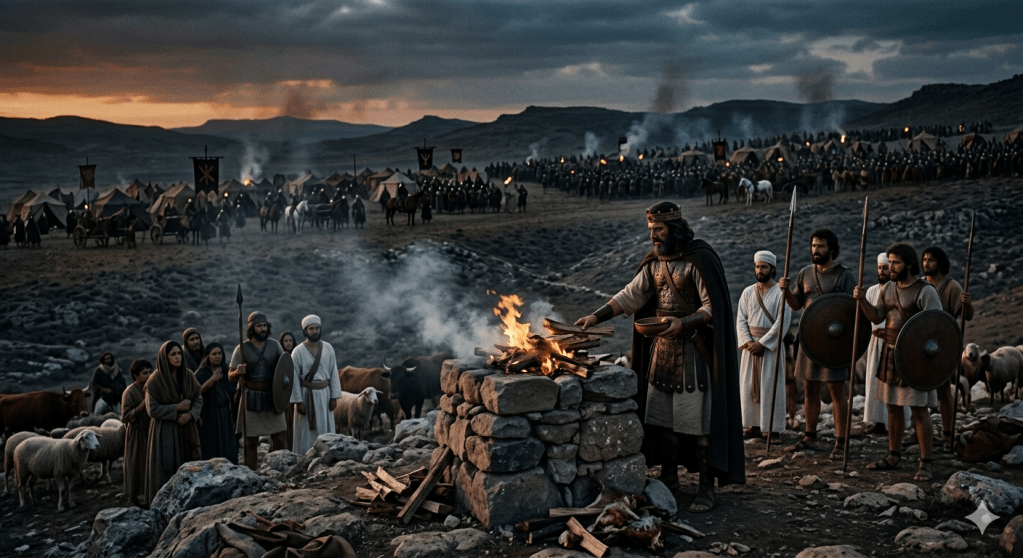
    But Saul’s kingship slowly unraveled – not because he lacked military skill, but because his heart posture toward God was fundamentally self‑centered. In 1 Samuel 13, Saul sees his odds of success in battle against the Philistines slipping away while he awaits for the arrival of Israel’s spiritual leader, judge, and prophet Samuel to come and offer a sacrifice to God – seeking God’s favor and blessing upon the battle to come. Impatient and anxious, Saul instead seizes the spiritual mantle he was never meant to carry and offers sacrifices himself. This was no small sin, but a blasphemous overreach that grieved the heart of God. Saul doesn’t repent. At Samuel’s rebuke, he deflects and offers excuses to attempt at justifying his actions (13: 11-12).

    Further into 1 Samuel, after sharp rebuke and the removal of God’s anointing, Saul’s language and actions demonstrate the behavior of a man who is more interested in maintaining his projection of power, and enviously attacking anyone he perceived as a threat to his power and image – even loyal subjects like David. Saul wrapped all of this in religious language, but at the core was a refusal to let God truly be king.

    Saul was “head and shoulders above” the people. His physical presence reassured Israel that they had a strong king, even when his inner life was shallow.

    American politics is saturated and infatuated with image. Trump, by design, projects wealth, dominance, and success: gold adornments, high-rises, bold promises, sharp insults, and the constant projection of winning. For many, this image of strength mattered more than deeper questions of truthfulness, humility, or moral character. In that sense, like Israel, we were drawn to a king who “looked the part.”

    Saul insisted, “I have obeyed the voice of the Lord,” even while keeping what God had forbidden (15:13–15). He measured obedience in terms of outcomes that suited him.

    In Trump’s case, many Christians excused or rebranded clearly unchristian behaviors – pride, cruelty in speech, contempt for enemies – because he delivered on certain political outcomes: judges, policies, perceived protection of the church. The moral calculus became, “As long as he fights for us, we can live with the rest.”

    That doesn’t mean every policy was wrong, but it does echo Saul’s mindset: partial obedience wrapped in religious language and defended as “necessary.”

    Saul’s reign was marked by a snowballing insecurity. Every song that praised David felt like an existential threat: “They have ascribed to David ten thousands, and to me they have ascribed thousands… What more can he have but the kingdom?” (18:8).

    Trump’s rhetoric often reveals a similar fragility: constant need to boast crowd sizes, ratings, victories; relentless attacks on critics; deep sensitivity to perceived slights. The strongman persona often looks like Saul’s armor – impressive on the outside, hiding a fearful heart within.

    But, if you’ve chosen to read this far you may wonder why I’ve found it necessary now to post these thoughts. Why does this matter to me as a pastor? Why should this matter to the church?

    The more I read Saul’s story, the less I find myself asking, “How much is Donald Trump like King Saul?” and the more I find myself asking, “How much are we like Israel?”

    We were afraid of cultural loss, so we demanded a strong king to “fight our battles.”

    We were willing to overlook un-Christlike behaviors if we thought he would secure our safety.

    We listened more readily to voices that promised protection and power than to the quiet voice that called us to repentance, holiness, and sacrificial love of enemies.

    And Trump has, indeed, won some battles that the church has been passionately fighting. The selection of a Supreme Court justice instrumental in the reversal of pro‑abortion legislation like Roe v. Wade was one such landmark. He has pushed back on what many of us see as the serious harms of gender‑transition procedures for children and on policies that allow biological males access to spaces traditionally reserved for women’s privacy and safety. He has built a reputation as a “friend of the church” by defending religious liberty and the right to assemble for worship.

    Likewise, Saul – for all his faults, failures, and insecurities that eventually consumed him – did not openly champion the foreign gods or morality of surrounding nations. Those nations embraced practices we would rightly name as evil: child sacrifice and the idolization of sexual immorality and prostitution as acts of worship. In a different presentation package, these issues are still at stake in modern American politics. Though Trump has had his fair share of moral failure, especially in his past, on many key policy issues he has held a generally conservative line.

    But somewhere along the line, this has made President Trump a legendary figure of sorts for a large swath of the church. “We finally have the strong pro‑Christian leader we’ve always wanted,” seems to be the resounding sentiment. “We can look past the combative, uncharitable rhetoric, the pride, and the contempt because he fights for the church.” But is his leadership really a net positive for the church? Not for America. For the church.

    On Monday morning, many awoke to a startling social media post by President Trump depicting him in the white robe and red sash or stole that, in the art world, is almost universally synonymous with Jesus Christ. His hands were aglow with mysterious power as he touched the head of a bedridden man in need of healing. For many of us, the implication was hard to miss: Donald Trump had placed his own image in a role that Christian art typically reserves for Jesus Himself.

    This was not dramatically different from the kind of social media content he often shares. He (or his team) has used AI‑generated images with regularity, both to demean opponents and to cast himself as various heroic or powerful figures. But this time, for many believers, it crossed a line.

    The Holy One, existent before all time and all creation – the Alpha and the Omega, the King of kings and Lord of lords, the perfect spotless Lamb whose blood alone is sufficient to cover every sin and whose resurrection is our only hope for this life and the next – was effectively echoed by a political image. The one who will return in righteous judgment and rule with the Father in the new heavens and new earth was implicitly paralleled with a human leader. However it was intended, the effect was to place Trump in a space that belongs only to Christ.

    The backlash, even among many who are usually strong supporters, was quick and decisive. “This is not okay,” was the prevailing sentiment among Christians.

    It was as if we were watching, in real time, a modern echo of Saul seizing the sacrifice and stepping into a role that was never his to take. After a few hours, the post was removed. When asked about it later, Trump said he had posted it because, in his mind, he looked like a doctor. It is difficult to reconcile that explanation with the image itself. Rather than clearly acknowledging that the post was inappropriate, there was an attempt to minimize and explain it away.

    If you place that moment next to 1 Samuel 13, the parallels are sobering.

    And the reason this matters is because protecting the message and the witness of the church is far more important than defending our institutions, our political influence, or our positions of power.

    Many believers I’ve spoken with have written off his behavior and rhetoric as the necessary cost of protecting the interests of the church by protecting American liberty – not merely tolerating his leadership, but at times embracing it enthusiastically. I’ve known many sincere Christians who express their support through red hats, flags, yard signs, and bumper stickers. For some, the very qualities that trouble others – the macho, crude, combative nature of his leadership – are seen as part of what makes him effective. “He fights,” they say. “He doesn’t back down.”

    Around all three elections he has been a part of, I’ve been asked as a pastor to pray specifically for Trump’s victory because “he has been chosen by God to lead our nation.” I’m beginning to believe those appeals may have been right – but perhaps not in the way many people assumed. Saul, too, was anointed by God to lead His people. Not as an instrument of grace, but, at least in part, as an instrument of judgment.

    When Israel asked for a king, God warned them what it would cost. They would gain the security they craved, but they would also bear the weight of a leader who did not fully share God’s heart. They would still be called God’s people, but their life together would be marked by compromise, conflict, and confusion about where their true hope lay.

    I am concerned that we are in a similar place.

    The question is not simply, “Is this policy good or bad?” or even, “Will this candidate protect our freedoms?” Those questions matter, and Christians should wrestle with them seriously. The deeper question is, “What story does our political enthusiasm tell about the God we serve?”

    When we rally more passionately around a personality than around the person of Jesus; when we excuse what we would otherwise call sin because it is “on our side”; when we are quicker to defend a leader than to lament his pride or blasphemy – our neighbors are watching. They are learning from us what we truly value, what we truly trust, and whom we truly worship. Gains we make politically should give us pause if they cost us evangelically.

    Our witness is more precious than our position. Our credibility for the gospel is more valuable than our place at the table of power. The church has suffered loss, persecution, and marginalization many times in history and has often emerged purer and more compelling. But whenever the church has traded its prophetic voice for proximity to Caesar, it has always paid a devastating price.

    I am not arguing for political withdrawal, nor am I suggesting that Christians may not, in good conscience, reach different conclusions about candidates and policies. I am pleading, instead, that we remember what is at stake. We are first and foremost ambassadors of a crucified and risen King, not chaplains of any party or personality.

    If God has, in His sovereignty, given us a “Saul moment” in our national life, then perhaps the point is not that we finally have the champion we always wanted, but that He is exposing what we have come to want most. Maybe this is less a sign of divine favor than a gracious warning: do not put your trust in princes, in human beings, who cannot save (Psalm 146:3).

    So before we jump in to dismiss, let us wrestle honestly with these questions before and during the next event that one of our leaders puts us in an uncomfortable and unflattering place:

    • Does this adorn the gospel, or distract from it?
    • Does this make Jesus more believable to my neighbors, or less?
    • Does this reflect the character of the One who told us to love our enemies and bless those who persecute us?

    In the end, kings rise and fall. Courts shift. Laws change. Nations come and go. But the church’s calling does not. We bear the name of Christ. We proclaim His kingdom. We embody His cross-shaped love in the world.

    May we be willing to lose our personal upper-hand rather than lose integrity. May we be willing to surrender the trophies of our conquests rather than surrender our prophetic voice. And may we repent, where we have enthroned any earthly leader in our hearts, and return again to the only King who laid down His life for His enemies.

    Because the world does not ultimately need to see how fiercely we can defend our institutions. It needs to see how clearly we belong to Jesus.